
First Place: Desarrollo Autogestionario, A. C. (AUGE), Mexico.
A civil society organization that promotes the development of skills and abilities in the population theyserve, to help them confront their problems, to encourage their abilityto work together in an organized way , to expand freedom, reflection and personal decision-making, and to promote self-management, taking advantage of the resources available to them and building group solidarity. . This initiative responds to the need to offer loans to rural women who have no access to institutional channels of credit.
Through courses on social finance, communication and human development, for the past fourteen years the group has organized and provided consulting services to groups of women who are engaged in joint savings and internal lending processes. They are given training on the workings of boards of directors, credit unions, daily cash closing, and more. The organization’s main focus is on internal savings and has helped 3,210 women and their families. The women’s groups are increasingly self-managed and, in fact, 18 of them (with a total of 540 members), have grown into independent autonomous groups.
More info: http://www.auge.org.mx
Second Place: CE-Mujer,Dominican Republic.
The “Centro de Solidaridad para el Desarrollo de la Mujer”, (CE-MUJER), is a non- governmental, non-profit organization that works on improving the quality of life of the Dominicans and the promotion of a culture that promotes new values of fairness and personal relationships, family and social. CE-Mujer started its activities in 1990. Its work consists of developing technical education programs for women in marginalized sectors, in order to facilitate their integration into the workforce.
These programs contribute to women’s leadership and to driving public policies that foster equal opportunities. Women are taught trades traditionally dominated by men, such as painting, upholstering, woodcarving, domestic appliance repair and others. Thanks to this training, these women have created micro-businesses where they work and create jobs for other women. The program has directly benefited 4,496 low- income women who have received training to enter the workforce, 703 women who earn an income by offering ambulatory services and 209 who have established their own organizations and micro-businesses.
More info: http://america.volensarchive.org/CE-MUJER.html?lang=es
Third Place: Associação Para Valorização de Pessoas com Deficiência (AVAPE), Brazil.
La AVAPE (Associação Para Valorização de Pessoas com Deficiência is a philanthropic social assistance organization which acts in the care and defense of rights, promoting the inclusion, rehabilitation and training of people with all disabilities and people in at-risk groups. Since its founding in 1982, the mission of AVAPE has been to promote the competencies of special needs individuals based on the precepts of independence, security and dignity. It has been a pioneer in the development of programs of social inclusion for special needs individuals through clinical rehabilitation, professional training, group interactions, social networks and professional job placement. AVAPE NET, an initiative sponsored by the Inter American Development Bank, offers professional opportunities in telemarketing for special needs individuals, creating 423 jobs in that sector to date. This initiative has now become very important due to legislation that obligates companies to have a minimum of between 2% and 5% of special needs individuals on the staff.
More info: http://www.avape.org.br/portal/es.html
The Awards Ceremony
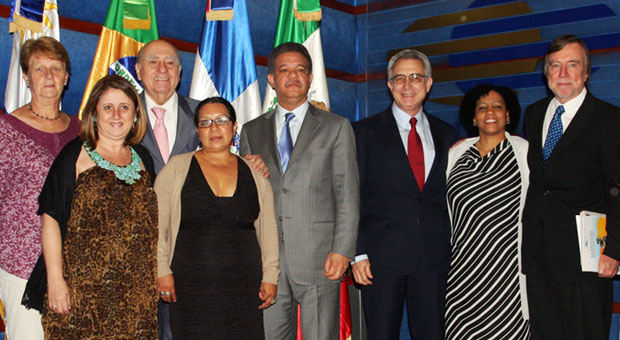
The Awards Ceremony 2011 was held on November 11, 2011 in Santo Domingo, Dominican Republic. The ceremony took place at the headquarters of the Global Foundation for Democracy and Development (FUNGLODE) and was chaired by Dr. Leonel Fernandez, President of the Dominican Republic.